
About Deadhead Calculation Formulas
There are four formulas that Schedule Server can use to calculate trip costs for deadhead:
- Formula 1
- Formula 2
- Formula 3
- Formula 4
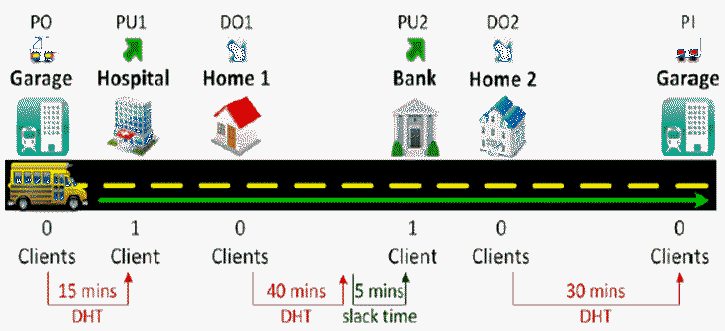
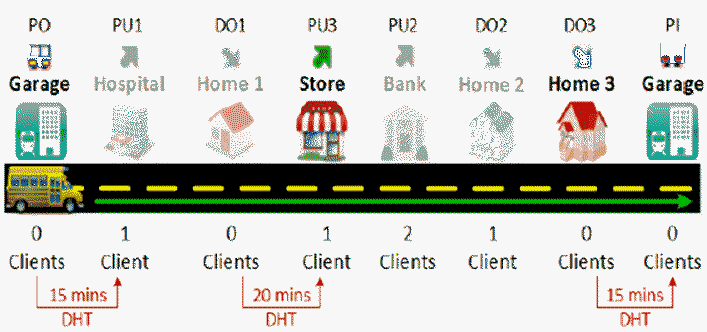
After Trip 3 (PU3/DO3) is inserted
Note that the example calculations for each formula do not show that one way of calculating deadhead cost is better than the other. Selecting a formula to be used at a site is dependent on that site’s needs (for example, reducing slack or deadhead time) and should be used with caution. If in doubt, select formula 2, which considers slack and deadhead time without severe penalties.
For the purpose of the examples in this section, the values to be used in each calculation are listed in the following table:
| Variable | Description | Minutes | Seconds (used in calculations) |
|---|---|---|---|
|
dht1 |
Deadhead Time Before | 85 | 5100 |
| dht2 | Deadhead Time After | 50 | 3000 |
| slack1 | SlackTime Before | 5 | 300 |
| slack2 | Slack Time After | 0 | 0 |
| threshold | Threshold (CWDHTHT) | 15 | 900 |
Formula 1
This method of calculation is the most sensitive way of determining how deadhead affects a trip’s cost because it relies heavily on the amount of slack available in a run’s itinerary. Its purpose is to incentivize the reduction of deadhead and slack.
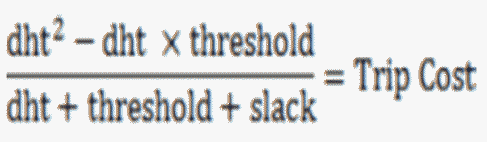
| DH Event (Before) | dht1 | Slack1 | Threshold | Formula 1 |
|---|---|---|---|---|
| PO - PU1 | 600 | 0 | 900 | -120 |
| DO1 - PU2 | 2400 | 300 | 900 | 1000 |
| DO2 - PI | 1800 | 0 | 900 | 600 |
| Total | 1480 | |||
| DH Event (After) | dht2 | Slack2 | Threshold | Formula 1 |
|---|---|---|---|---|
| PO - PU1 | 600 | 0 | 900 | -120 |
| DO1 - PU3 | 1200 | 0 | 900 | 171.429 |
| DO3 - PI | 9 | 0 | 900 | 0 |
| Total | 51.429 | |||
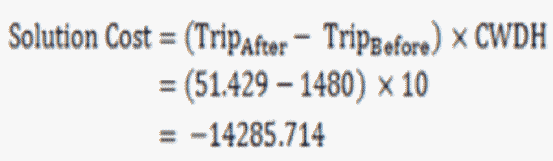
Therefore, calculating the cost of inserting trip 3 (PU3/DO3) using formula 1 is -14285.714.
Formula 2
This method of calculation is similar to the first formula, except that it disregards deadhead events where the deadhead time is equal to or less than the threshold. For best results, Trapeze recommends using this formula for deadhead calculation.
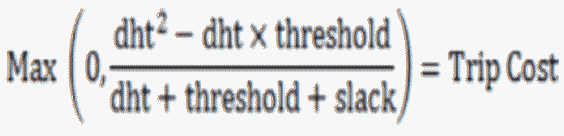
| DH Event (Before) | dht1 | Slack1 | Threshold | Formula 2 |
|---|---|---|---|---|
| PO - PU1 | 600 | 0 | 900 | 0 |
| DO1 - PU2 | 2400 | 300 | 900 | 1000 |
| DO2 - PI | 1800 | 0 | 900 | 600 |
| Total | 1600 | |||
| DH Event (After) | dht2 | Slack2 | Threshold | Formula 2 |
|---|---|---|---|---|
| PO - PU1 | 600 | 0 | 900 | 0 |
| DO1 - PU3 | 1200 | 0 | 900 | 171.429 |
| DO3 - PI | 9 | 0 | 900 | 0 |
| Total | 171.429 | |||
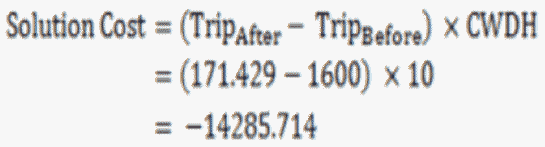
Therefore, calculating the cost of inserting trip 3 (PU3/DO3) using formula 2 is -14285.714.
Formula 3
This method of calculation is the simplest one to use because it focuses solely on deadhead time. However, using this formula cannot determine whether decreasing deadhead will also reduce slack time. Deadhead is penalized only if deadhead time is greater than the threshold.
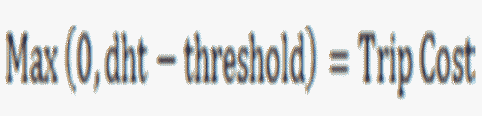
| DH Event (Before) | dht1 | Slack1 | Threshold | Formula 3 |
|---|---|---|---|---|
| PO - PU1 | 600 | 0 | 900 | 0 |
| DO1 - PU2 | 2400 | 300 | 900 | 1500 |
| DO2 - PI | 1800 | 0 | 900 | 900 |
| Total | 2400 | |||
| DH Event (After) | dht2 | Slack2 | Threshold | Formula 3 |
|---|---|---|---|---|
| PO - PU1 | 600 | 0 | 900 | 0 |
| DO1 - PU3 | 1200 | 0 | 900 | 300 |
| DO3 - PI | 900 | 0 | 900 | 0 |
| Total | 300 | |||
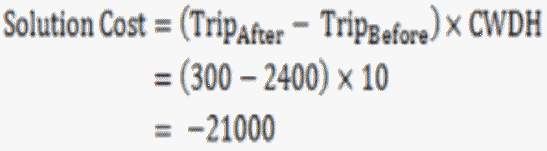
Formula 4
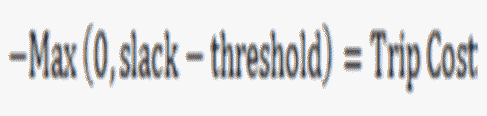
This method of calculation ignores the amount of deadhead time within a run’s itinerary. It focuses only on slack, and the threshold value determines the minimum amount of slack a site would like to see between two events. Trapeze recommends using one of the other deadhead calculation formulas if deadhead time is an issue at your site.
| DH Event (Before) | dht1 | Slack1 | Threshold | Formula 3 |
|---|---|---|---|---|
| PO - PU1 | 600 | 0 | 900 | 0 |
| DO1 - PU2 | 2400 | 300 | 900 | 0 |
| DO2 - PI | 1800 | 0 | 900 | 0 |
| Total | 0 | |||
| DH Event (After) | dht2 | Slack2 | Threshold | Formula 3 |
|---|---|---|---|---|
| PO - PU1 | 600 | 0 | 900 | 0 |
| DO1 - PU3 | 1200 | 0 | 900 | 0 |
| DO3 - PI | 900 | 0 | 900 | 0 |
| Total | 0 | |||
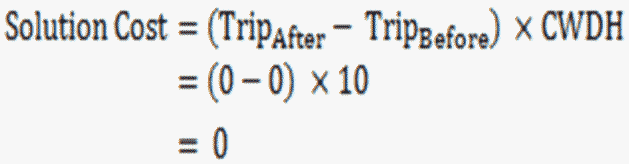
Therefore, calculating the cost of inserting trip 3 (PU3/DO3) using formula 4 is 0.