
About Triangulation
Triangulation is a way of figuring out the distance from three separate locations.
PASS calculates distances using "triangulation," when computing speed factors. For example, on the map below there is a client pick-up location (point A) and the client's drop-off location (point B), by adding a third point (point C), creates a triangle when lines are drawn to connect all the points together:
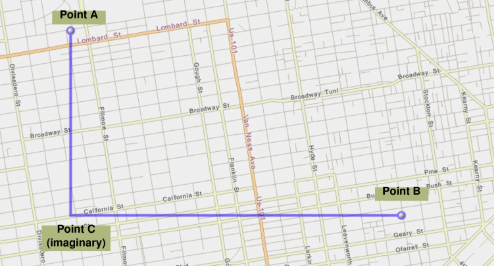
Point C is always placed in a spot that will create a right angle (90 degrees). The distance from points A and C and the distance from point B to C are then measured and added together to calculate the approximate distance between points A and B, which is then used to calculate the estimated trip time.
When setting up triangulation speed factors, you can specify speed factors for weekdays (Monday to Friday) and weekends (Saturday and Sunday) that apply to various times of the day as well as by distance. If both time and distance speed factors are defined, PASS first calculates the speed factor by time and then by distance.