About Price Indexes
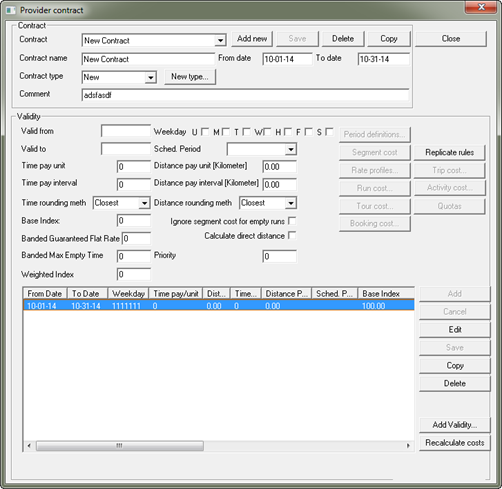
The base index on a validity for a provider contract allows rates to be adjusted when a new validity is created.
Base indexes should be set to 100 for a contract's first validity so that subsequent validities will have a base index that is easy to compare to it.
- On Account Index
- Used in the computation of the rates for a provider contract when a new validity is created. The value can be an index approximation about the future.
- Final Index
- Entered when the validity period ends; states what the true index is.
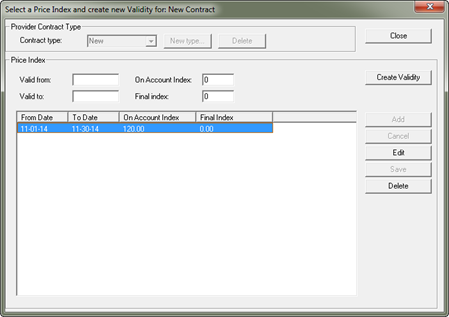
When a new validity is created for November 2014, notice that the base index of a new validity is equal to the On Account Index from the price index.
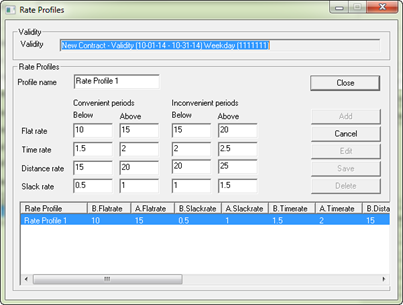
All rates for this new validity are the rates from the one from October calculated as Base IndexNew valdity/Base IndexOld validity, meaning that the rates have increased with 20% (that is, 120/100).
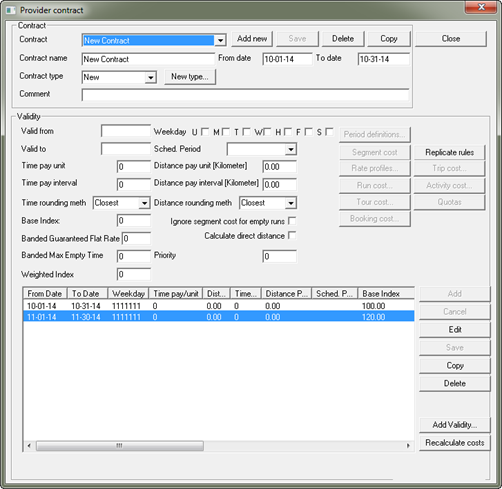
Any rates defined in the other costing dialog boxes (for example, segment costs, rate profiles, run costs) are automatically adjusted.
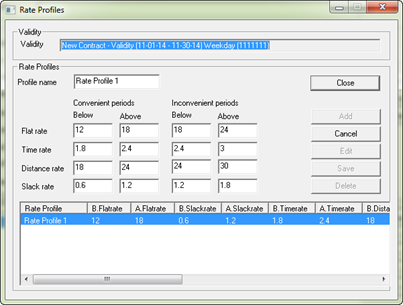
The following image shows the original Rate Profiles dialog box for October 2014 displaying the rates before a price index is added:
The following image shows the new rate profile for November 2014 after the added price index increases all rates by 20%: