
Vehicle Capacities
Capacities allows system administrators to define the maximum seating capacity of each vehicle for a variety of space type and mobility aid combinations.
The Capacity Type table can be used as a reference to help schedulers fill each vehicle to its maximum capacity.
For example, if Type 1 is a vehicle that has four variations on the maximum seating capacity, then variation #1 may allow 4 ambulatory passengers (AM) and 2 wheelchairs (WH) and variation #4 may allow 1 ambulatory passenger and 3 wheelchairs. Available space types are defined by a system administrator in ancillary data.
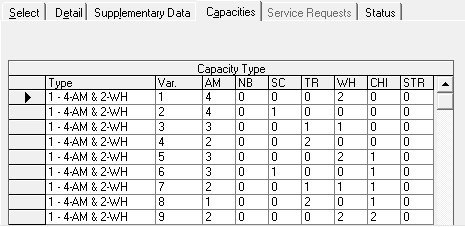
| Column | Description |
|---|---|
| Type | Type of vehicle. |
| Var | Variation of the vehicle type. If there are four ways that the seating capacity of the vehicle can be filled, then four different variations should be created for the vehicle type. For example, four ambulatory passengers and two wheelchair passengers can ride on a vehicle that could also take four ambulatory passengers and one scooter passenger. |
| Space Types | Space types defined in ancillary data are shown in separate columns. For each vehicle type, the accumulated number of all space types make up the maximum seating capacity. |
| Mobility Aids | Mobility aids may be shown in separate columns if they can affect vehicle capacity. |