
What a "Bad Trip" Looks Like
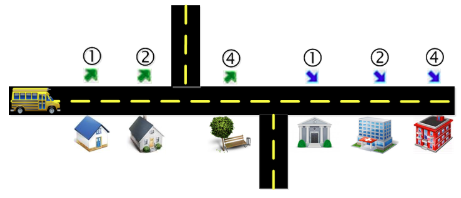
A Bad Trip is a trip on a run that deviates from the main road.


However, if Trip 3 is removed from the run, the vehicle can quickly pick up and drop off Trips 1, 2, and 4 without detouring from the main route. The score of this run, once Trip 3 is removed, could be 4. By rescheduling Trip 3, the cost could increase back up to 9. In this case, the score is calculated as:
(RescheduledScore - UnscheduledScore) = (9 - 4) = 5
Because not all trips can be considered “bad” by looking at a map, the Bad Trip Locator relies on user-defined costing weights that determine the importance of a condition, from 0 to 25, where 0 is considered unimportant and 25 is considered very important, when identifying and rescheduling or unscheduling trips. For a list of costing weights and their descriptions, refer to the Costing Weights section in the PASS System Administrator and User Guide.