
Using TSDE Import
Importing data refers to processes such as loading a file, text, or data prepared with one application into another application while exporting data is the process of sending data from one application to another application.
- Accepting having the stops before nodes or nodes before stops in the pattern point files
- Using a single RunId in the MasterRun table for all TSDE Records with the same Service/Division/Run Number
- Preventing the insertion of the same relief opportunity more than once into the Trip Times table after a run with different exceptions has been cut at the same point
- After importing line stops and copying stops from another sign-up period, it matches the patterns of the source sign-up period. If line points are not imported, it merges the matching stops in a manner similar to how stop patterns are merged.
-
To open the Data Exchange screen, click .
By default, the TSDE Import screen is displayed.
-
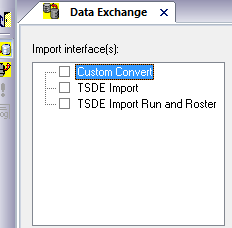
In the Import interface(s) pane in the Data Exchange screen,
-
Custom Convert - Allows you to convert data, which is in a third party format, to Trapeze format in order that you can import the data.
-
TSDE Import - Allows you to import basic scheduling data such as stops, lines, trips, and blocks.
-
TSDE Import Run and Roster - Allows you to import scheduling data and runs and roster data.
-
-
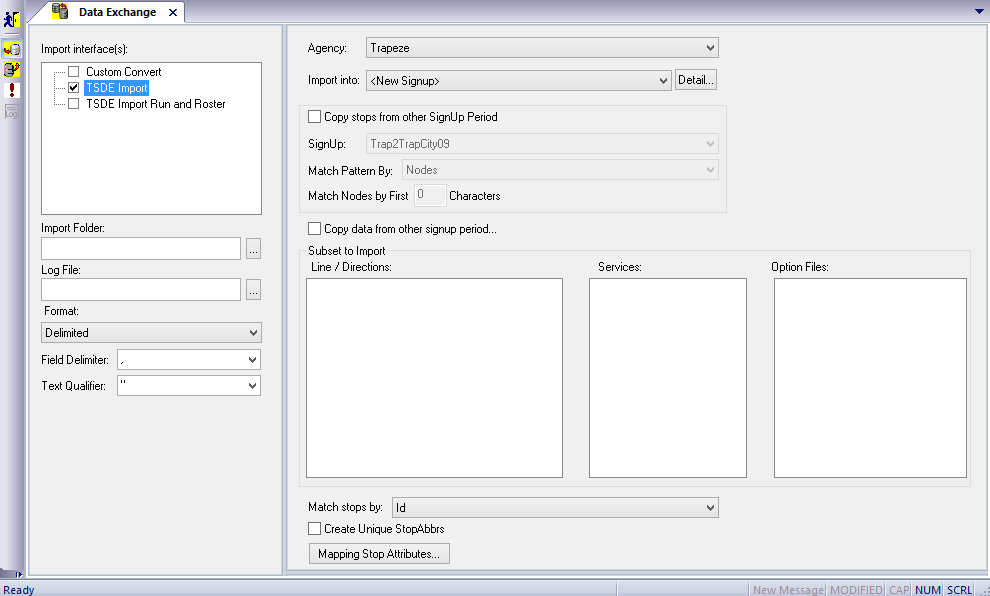
In the Import interface(s) pane, select the TSDE
Import checkbox.
Additional fields are shown on the right pane and below the Import interface(s) pane.
-
Click the ellipsis button beside the Import Folder field.
The Browse for Folder dialog appears.
-
Select the folder containing the files created in the export process, and then click
OK.
The Subset to Import frame in the right pane is filled in with the lines, services, and other optional data contained in the selected files.
-
Click the ellipsis button beside the Log File field.
The Browse for Files or Folders dialog appears. Create a log file for the import process. The path to the file is displayed.
-
In the Format dropdown list, select the appropriate format:
Delimited, Fixed Width, or XML.
- If you selected Delimited, the Delimiter and Text Qualifier fields are activated.
-
In the Field Delimiter list, select the symbol to distinguish the fields. for example, select comma (,) if the data is delimited by commas.
-
In the Text Qualifier list, select the appropriate mark. The double quotation marks () is recommended.
- (In a multi-agency environment) In the Agency list, select the agency from which you want to import data.
-
In the Import into dropdown list, select the sign-up period to
which you want to import.
-
To import into a new sign-up period, choose <New Signup>.
- To import into an existing sign-up period, choose the sign-up period from the dropdown list. Click the Detail ellipsis button.
The SignUp Details dialog displays information on the selected sign-up period.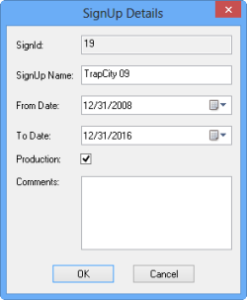
-
- Change the From Date and Time Date if you only want data from a specific time period. Type a comment in the Comments field as necessary. Click OK.
- Optional:
To copy stops data from another sign-up period:
- Optional:
To copy data other than stops from another sign-up period:
- On the right pane, select Copy data from other signup period - If selected, you can choose the data that you want to import in the Copy data from other signup dialog.
- In the Signup dropdown list, select the sign-up period from which you want to copy.
- In the Copy Options dropdown list, select the data elements that you want to copy and then, click OK.
- Optional: To modify the subset of data to be imported, select or clear the appropriate line/directions, services, or other options in the Subset to Import pane.
- In the Match Stop by dropdown list, select how you want the stops matched: Id or Abbr. If the data being copied has an ID or Abbr that matches the data it is being copied into, it overwrites the data.
- Optional:
Select Create Unique StopAbbrs to change names of duplicate Stop
Abbrs of the data being copied. For example, Stop EXPO for Line 1 and Stop EXPO for Line
10 are changed to Stop EXPO1 and Stop EXPO2, respectively.
A suffix is added to the abbreviations to make the stop abbreviation unique.
-
Click the Mapping Stop Attributes button.
The Mapping Stop Attributes dialog is displayed. The Attribute Name column shows the stop attributes from the source data. The FieldName column contains Trapeze field names as in the Stops table. The FieldLabel column contains the name of the field as it appears in the Trapeze application.
-
Click a field in the FieldName column and select the appropriate
matching attribute from the list.
If supplementary information has been updated in the Trapeze application, that is, user fields renamed, the field label is shown and can be selected from the Field Label list. If the field name is selected from the FieldName list, the FieldLabel and FieldType fields are automatically filled in.
- After completing the list of attributes, click OK.
- To save all of the import settings for future imports, click the Save button and save the ini file.
- Optional: To load a set of saved import settings, click Open and select an ini file.
-
To run the TSDE Import, click Execute Interfaces:
