
About Bump Runs
A bump run is a temporary run used to hold trips until they can be scheduled to a suitable run.
By bumping a run to a bump list, which is like a taxi type run, other trips can be better accommodated and make overall scheduling solutions more cost effective.
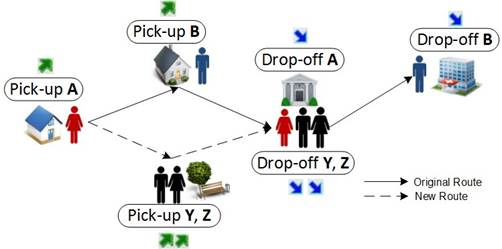
Bumping may also be referred to as auto-bumping or classic bumping. For example, if bumping is enabled for a run and Trip A is scheduled to it, Schedule Server may move Trip B to another run because it deems Trip A to be better on the run (for example, less detouring from the main route or more clients can be picked up by taking another route).
Note that a bumped run during scheduling is not the same as when the Bad Trip Locator (BTL) job moves a run to a bump run. The BTL is configured to move bad trips based on a trip's score instead of trip distance or clients transported.
- Pick up Client A.
- Pick up Client B.
- Drop off Client A.
- Drop off Client B.
However, if a new trip is booked to pick up Client Y and Client Z, the system will evaluate the possibility that Client B will be bumped to a taxi vehicle. This bumping occurs only if the resulting overall solution is cheaper than the original solution (as defined by the scheduling costing weights and the overall fare).
As a result, the run may be rescheduled to reflect the following changes:
- Pick up Client A.
- Pick up Client Y and Client Z.
- Drop off Client A, Client Y, and Client Z.
When scheduling trips to include the possibility of using bump runs, ensure that the correct Bump Rule solution parameter is selected.