
Adding Detailed Information to Location Records

Once you have created a location record you can type detailed information about the location on the Detail tab.

Before you begin

Common Locations must be open.

Procedure

  1. Click the Detail tab.
  2. Provide the following information as required:
    1. Type the Name of the location.
    2. Click the location Type that best suits your location.
    3. Optional: Define an Alias for the location.
      Location aliases can be used as a shortcut when searching for locations. For example, in Trip Booking, in the Destination pane, when Location is selected in the address type list, you can type the alias in the field next to the address type list.

      The address type list showing Location selected and the alias ACC in the right-side field.
    4. Optional: Select InActive if the location is not currently in use for clients to be picked up or dropped off.
      Locations marked as inactive will not appear in Trip Booking for selection can be filtered out when searching for locations.
    5. Optional: Select Needs special attention if the location’s comments should be shown in Trip Booking.

      If this location is selected as a client’s pick-up or drop-off destination, then an information window will be shown to notify the reservationist about these additional comments.

    6. Optional: Select Restricted Access if drivers and passengers need special permission to access the location.
      After the location has been defined as a restricted access site (for example, a military base), then client and employee records must be updated to allow access to these locations.

      In Task > Clients, click the Detail tab, and in the Location Restricted Access Allowed field, select the locations that the client can access.

      In Task > Employees, click the Detail tab, and in the Location Restricted Access Allowed field, select the locations that the employee can access.

      Runs that are going to a restricted location while they have clients or employees not authorized to access that location incur an R violation on the event at which unauthorized passengers are included.

      A client or employee not marked as allowed at a restricted location is assigned to a run during a period of time where the run will perform an event at that restricted location.

      Variations of this violation are found on the applicable restricted location trip event in the Run Itinerary:
      • R-99999 (where 99999 is the Client ID of the passenger who is not allowed)—Restricted Access Client ID violation

      • R-D—Restricted Access Driver violation

      • R-CD—Restricted Access Co-Driver violation

      To avoid R violations, passengers with restricted access privileges should be picked up before passengers without restricted access privileges and dropped off after passengers without restricted access privileges.

  3. Define the time it will take clients to board or alight the vehicle at this location:
    1. Type the Load time.
      This is the time it should take any client to get on the vehicle.
    2. Type the Unload time.
      This is the time it should take any client to get off the vehicle.
    3. Type the Multiple Load Factor.

      This is the value used to calculate the time it takes to load multiple clients at a specific location.

      For example, three clients board at a location. The load time is four minutes and the load factor is 0.5. Using the calculation 0.5 x 4, the first client is loaded in four minutes, and the second and third at two minutes each.

      When you book a trip, the load and unload times you type in this screen are calculated on top of other load and unload times set in other PASS screens, such as Client Registration and Space Types ancillary data.

  4. In the Vehicle Type Exclusion field, click any vehicle types that cannot be used with the location.
    For example, the vehicle type is excluded because it requires a large parking area to maneuver and the location is at a busy intersection.
    If trips have already been booked for this location, run the location change wizard to update the bookings with the vehicle type exclusions.
  5. In the Jurisdiction Polygon field, click the polygon to which the location belongs.
    Polygons listed here are determined by the polygon type selected in Tools > System Properties, on the Profile tab, under PASS Scheduling > Polygon types > Jurisdiction polygons.
    When you type and geocode an address, the jurisdiction polygon within which it is located is automatically shown in the Jurisdiction Polygon field. Sometimes, an address may be located within more than one polygon. Click the field to show the list. An asterisk (*) marks the polygons that the address falls under.
  6. In the Address fields, type the address of the location and geocode it on the system map.
  7. Type the Phone number of the location.
  8. Optional: If additional contact information must be defined, click the Contact Info button.
    Use the Contact Category dialog box to add more contacts and contact methods for the defined Contact Type and Facility.
  9. Optional: Identify an accessibility option for the location:
    1. Click the Accessibility button:
      Rectangle on a line with blue around the rectangle.
      The Accessibility button also appears in other screens, such as Trip Booking and Client Registration. It provides additional information on the accessibility features of the location.
    2. Click any applicable accessibility options.
      To add or edit accessibility ancillary data, click File > Ancillary Data > Fixed > Accessibility.
    3. Click OK.
  10. Type a Comment about the location.
    This comment appears in Trip Booking if the location is selected as the Origin or Destination of the trip.
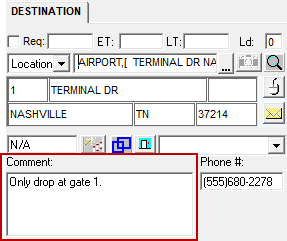
    The Destination frame in Trip Booking with the Comment field circled in red.
  11. Optional: Define an audience for the location:
    To define who can see a location record, the Trapeze4 > Audiences > Edit Audiences security permission must be granted.

    To see a location record's audiences, the Trapeze4 > Audiences > Edit Audiences security permission must be granted.

    1. In the Audiences frame, click the ellipsis (...) button.
      The Audiences dialog box appears.
    2. Click the Add New button.
      A new row appears below the last record on the left side of the dialog box.
    3. In the Audience field, type the name of the audience that should be able to access the location record.
    4. In the Description field, type a brief description of the audience.
    5. Click the User or User Groups button and select any users or users groups that should have access to or should not have access to the location record.
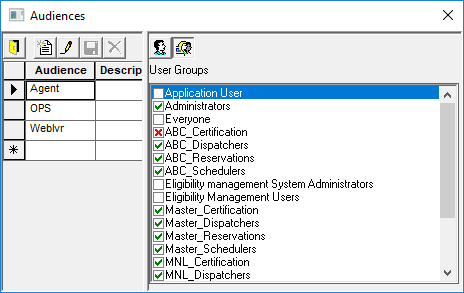
      The Audiences dialog box showing a list of User Groups for Agent.

      Click the check box for the user or user group until the desired setting appears.

      For Agent, the following
      green check mark
      The user or user group has permission to access the location (granted).
      red x
      The user or user group does not have permission to access the location (denied).
      empty check box
      The user or user group does not have permission to access the location (none).
    6. Click the Save button:
      Diskette.
    7. Add any additional audiences as needed.
    8. Click X.
      The new audiences are shown in the Audiences frame.
  12. Add any required Supplementary Data information.
  13. Click the Save button:
    Diskette.