
Defining Trip Costs
Trip cost rules describe the costs incurred when going from point A to point B.
Before you begin
About this task
Time periods must be defined before trip costs, which are a type of time cost. If there are no pricing differences throughout the day, define a time period of 0:00 to 24:00 to indicate that all of the rules apply to all time periods.
Procedure
- In the Contract frame, click the contract for which to define trip costs.
- In the Validity frame, select a validity in the grid.
-
Click Edit.
The buttons in the Validity frame become available.
-
Click Trip cost.
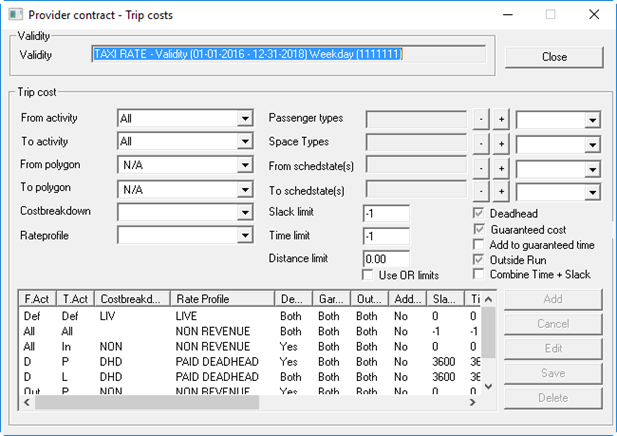
The Provider contract - Trip costs dialog box appears.
-
In the Trip Cost frame, provide the following information:
- From activity and To activity
- Click the activity codes to identify the start and end activities of the trip
cost. See Activity Codes for a list and
description of activity codes.Note: Define a DEF - DEF activity set. This (default to default) trip cost rule serves as a base rule and is used when nothing else applies. The advantage of having the default trip rules is that only deviating behavior needs to be defined, (for example, going to or from breaks, or going to or from no shows). More than one default rule can be defined, because you might want to have a default distance Costbreakdown, and a default time Costbreakdown.
- From polygon
- Click the origin polygon in the list.
Polygons listed here are defined for the Para Service Area selected in , on the Profile tab, in .
- To polygon
- Click the destination polygon in the list.
Polygons listed here are defined for the Para Service Area selected in , on the Profile tab, in .
- Cost breakdown
- Click the cost breakdown type.
- Rate Profile
- Click the profile that determines the actual pricing of any trip that meets the specified criteria.
- Passenger type
- Click the appropriate passenger type and then click the plus sign button
(+) beside the menu.The selected type is shown in the Passenger types field.

(Optional) Add another passenger type.
(Optional) To remove a passenger type, click the minus sign (-) button.
- Space Types
- Click the appropriate space type and then click the plus sign
(+) button.
The selected type is shown in the Space Types field.
Add another type if necessary.
- From schedstate(s) and To schedstate(s)
- Click the schedule status of the from activity and to activity to determine
whether the calculation is computed from the scheduled time, the arrive time, or the
depart time, which can be critical to hourly charges.
Having no schedule status means that the rule applies for all schedule statuses.
Only set a schedule status if you need to distinguish different rules for specific schedule statuses.
- Deadhead
- Indicate whether the rule applies for deadhead only.
If the check box is left clear, the rule excludes deadheads.
If the rule applies to both deadheads and trips which are not deadheads, click the check box twice. A gray check mark appears.
- Add to guaranteed time
- Select whether to add any time computed to the guarantee time for the run.
- Outside run
- Select whether to cost times outside of the scheduled start and end times of the
run (that is, any time that counts towards an RnE or RnL violation).Note: The Guaranteed cost check box is no longer used. Guarantee costs are set in the Segment Cost dialog box.
- Combine Time + Slack
- Selecting this option combines the travel time and slack time and treats them as a single total when determining whether or not the Above/Below threshold has been exceeded.
- Slack limit
- (If applicable) The Above or Below
slack time cost calculation in the selected Rateprofile will
apply based on whether the slack time between the From
activity and the To activity is greater than or
less than the defined Slack limit value.
Typically, Slack limit is set to either -1 (if time charges do not apply) or 0 (if time charges apply to all slack time between the two activities). If the transit agency (that is, you) pays for slack time, a separate rule needs to be set up.
Set up a provider rate profile called Slack and a corresponding cost breakdown code, and then create a trip cost rule for it. Change the value in the Slack limit field, which is -1 by default, to 0. Alternatively, change the slack limit to 0 on the time rule and include both charges in the rate profile.
- Time limit
- (If applicable) Change the value, which is -1 by default, in the Time limit field to 0 if the time charges apply to all times between the two activities. The cost calculation in the selected rate profile applies to the time between the From activity and the To activity that is in excess of this amount. If set to -1, the time charges do not apply.
- Distance limit
- (If applicable) Change the value in the Distance limit field to 0 if the distance charges apply to all distances between the two activities. The cost calculation in the selected rate profile applies to the distance between the From activity and the To activity that is in excess of this amount. If set to -1, the distance charges do not apply.
- Click Add.