
About Eligibility Tests
Eligibility tests are criteria evaluated by PASS to determine whether a trip can be provided.
Automatic tests can be constructed for some, but not all, eligibility conditions. Conditions that are purely subjective (for example, good day or bad day) cannot be tested. Others may be tested using proxies. For example, dark can be defined as 5 P.M. to 6 A.M. from November 1 to March 31.
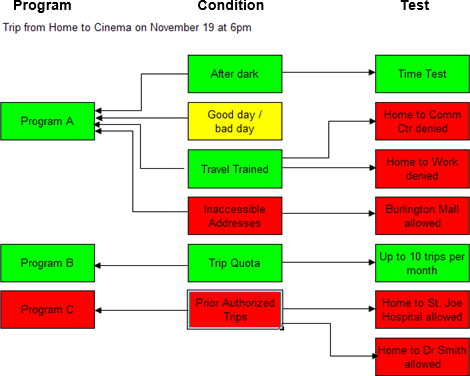
The following are examples of tests that Eligibility Tests is intended to support:
Non-spatial (date and time related) tests
- Earliest allowed time
- Latest allowed time
- Allowed days of the week
- Date ranges
- Minimum days booked in advance
- Maximum days booked in advance
Date ranges are an expected type of test. Note that a date test also is captured in the date range associated with the eligibility rule. These serve different functions. The eligibility test's date range determines whether the trip can be taken, while an eligibility rule's date range will allow differentiation of the defaults to be applied to the trip based on date. That is, there might be two eligibility rules with different date ranges and different defaults (rules); the date range on the eligibility rules would determine which default rules apply.
Trip quota tests
Data in the test criteria could include:
- Period type
- Period quota
This data is captured in eligibility rules.
Journey (origin-destination pair) tests
The most common type of test is to look for address pairs such as home to work, for which the rider has been travel trained and therefore is expected to use fixed route service. Finding a qualifying match means the trip is denied.
- Origin type (address, location type, or polygon)
- Origin value (address, location typeid, or polygon ID)
- Destination type (address, location type, or polygon)
- Destination value (address, location typeid, or polygon ID)
Leg (origin or destination) tests
- Leg type (address, location type, or polygon)
- Leg value (address, location typeid, or polygon ID)
The most typical example of this is to identify trips to or from an address that cannot be served by fixed route because of access issues from the nearest bus stop.
Fixed route (FX) availability tests
This requires PASS-IPA and an itinerary planner to determine whether a fixed route itinerary is possible between the origin and destination at the requested time.
Note that the ADA Service Area test combines spacial and temporal tests, checking that both the origin and destination fall within a polygon of a chosen type at the time that service is offered in that polygon. This test is recommended when serving several different programs and clients of different programs need to be confirmed against the applicable service area for that program. By setting the Check ADA user-defined property (found in by clicking , on the Booking Screen tab) to No and applying the test via an eligibility test instead, a polygon type can be selected for each program and its associated eligibility condition.