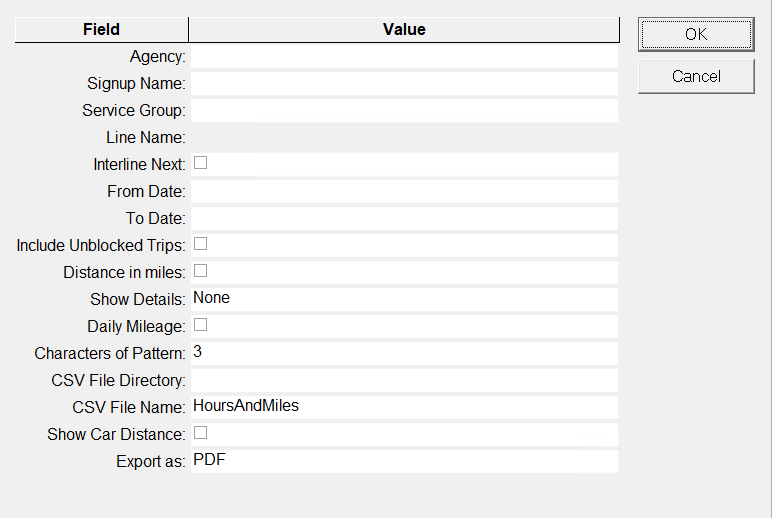
The Hours and Miles report provides summary revenue and non-revenue time and distance
statistics of selected lines within a specified time period, that is, from MM-DD-YY date to
MM-DD-YY date of a sign-up period.
The following graphic shows the Hours and Miles report parameters:
Parameter
Description
Agency
Agency code
Signup Name
Name of sign-up period.
Service Group
Service Group abbreviation.
Line Name
Line number. This field is enabled after you select the Signup Name.
Interline Next
If
selected, an Interline deadhead is added after the pull-out/before the pull-in. It
occurs between different nodes.
From Date
Start date of the time range covered by the report.
To Date
End date of the time range covered by the report.
Note: The From
Date and To Date of the time range must be
within the selected sign-up period.
Include Unblocked Trips
If selected, the trips that have not been blocked are included in the
report.
Distance in miles
If selected, the distance is shown in miles.
Show Details
Options are: None, Pattern Details, and RevenueNo Details (revenue number
details)
Daily Mileage
If selected, the daily mileage is included in the report.
Characters of Pattern
Number of characters of the pattern name to be displayed in the
report.
CSV File Directory
File directory where the csv file is stored.
CSV File Name
HoursAndMiles - This is the file name by default, which you can
overwrite.
Show Car Distance
If selected, trip distance is multiplied by the number of cars on the rail.
Export As
Allows you to select the format type of the report:
CSV (Comma-separated values file that is read with spreadsheet program)
Excel (Microsoft spreadsheet)
PDF (Read with Adobe Reader)
RTF (Rich Text Format)
WORD (Microsoft Word)
The following graphic shows an example of an Hours and Miles report:
The values in the Peak Vehicle column show the minimum number of
vehicles required during the peak periods, which vary by service and line.