
L
last in first out (LIFO)
Passenger who last boarded the vehicle is also the first passenger to get off the vehicle. Typically used in PASS.
late service
Vehicle operating behind schedule.
See also schedule adherence.
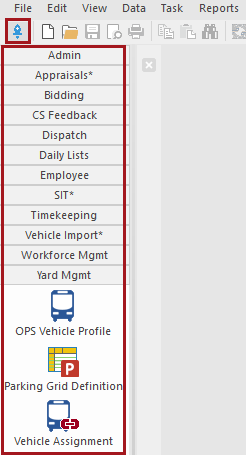
Launchpad
Feature available in Trapeze5 and Trapeze6 applications that holds extensions for easy access.
layover
- Time a vehicle is out of service between two consecutive trips to make up for
running time variations, traffic volumes, and passenger loads, to let the operator a
break, or to make sure that the vehicle departs on time.
Also called recovery time.
- In PASS, the time a client spends waiting at a transfer point for the second vehicle.
- On a route, the location where a vehicle is scheduled to dwell for a period of time.
- On a route, the action of dwelling for a period of time.
lead dispatcher
Manager, supervisor, or senior dispatcher at a transit agency.
Also called dispatch supervisor.
leg
Part of a passenger trip or driver travel from a pick-up point to a drop-off point. Typically used in PASS.
When a client is scheduled to travel from point A to point B to point C, it's considered a multi-leg trip.
lift
Platform that can be raised and lowered to help passengers (for example, wheelchair passengers) to board or disembark a vehicle.
light travel
(Used in UK) See deadhead.
line
A fixed route from an origin or start node to a destination or end node with in-between nodes.
Also called route and service (used in UK).
linear asset
line group
Trips or lines grouped together for optimal blocks. For example, lines that are interlined together would be placed in the same line group.
See also route group.
linked line
Used to establish (single) routes on which vehicles travel with destination signs displaying the second line of a set throughout the trip. For example, if lines 002 and 007 are linked together, the destination sign of the vehicle traveling from 002 to 007 shows line 007. When the vehicle travels from 007 to 002, the destination sign shows line 002.
Typically, vehicles working interlined routes change destination signs as the individual lines change.
See also through line.
linked trips
list view
live schedule
See schedule.
load
Number of passengers on board a vehicle at any point on a route.
See also maximum load point.
loaded schedule
Schedule available for viewing and for accepting Schedule Server activities in PASS.
Unloaded (past) schedules are also stored in PASS. Unloaded schedules can be viewed but not updated.
load factor
Ratio of passengers actually carried versus the total passenger capacity of a vehicle.
load time
Time it takes for a passenger to board a vehicle. Typically used in PASS.
Load times can be assigned to a client in several areas of the system and are used when calculating service times. Because load times are cumulative, Trapeze recommends they only be assigned to space types and, if needed, to individual passenger records.
log
Record of actions that's used to track database changes. Trapeze systems typically contain multiple log types.
loop(er)
- Layover or turnaround area for transit vehicles.
- Route that starts and ends at the same location in a single direction.
The graphic below illustrates two types of loops: A shows a route with a loop end and B shows a one-way or bi-directional loop route.
Also called a circular route or circular loop.
lost time and miles
Time and miles that scheduled bus service doesn't occur. For example, because of accident, equipment failure, illness, or construction delays.