
P
paddle
Document that details the scheduled trips to be operated, including the timepoints for each trip between pull-out time and pull-in time.
See also driver paddle and block paddle.
paid time
Time for which an operator is compensated.
This includes the time the operator is on the job but not operating a bus (for example, preparing for the operation of a revenue vehicle) and the time the operator is actually operating the vehicle (revenue and deadhead time).
pane
Distinct section of a screen in most Trapeze products.
Panes may be titled or untitled. For example, upper and lower panes, left and right panes, or the Days Off pane in the Unbid Work - Quota Inquiry screen in OPS.
parameter
Sometimes, groups of parameters are called parameter sets (used in INFO-Agent and PASS).
paraservice type
Paraservice types are created in Trapeze4 Workstation ancillary data ().
paratransit
Transit service for individuals who are temporarily or permanently unable to use public fixed route services. Typically, due to a physical ailment.
partial cafeteria
See cafeteria pick.
passenger
Individual traveling on a service vehicle.
Passengers may be clients, companions, service animals, or others.
Passenger Information System (PIS)
Provides real-time bus status information to passengers.
It can include predictions about arrival and departure times and information about service disruptions. It might be used at a transfer station or bus stop (for example, wayside signs) or remotely using a web browser or mobile device.
passenger miles
Total distance traveled by each passenger. For example, if a bus carries ten passengers who each ride for two miles, there are twenty passenger miles.
passenger type
Classification assigned to a passenger when generating an itinerary for a client in PASS.
Passenger types are defined in ancillary data. For example, Adult, Child, or Senior.
pattern
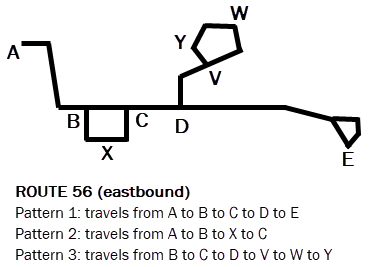
Unique pathway formed from a succession of stops and timepoints used in a single directional trip on which a fixed route vehicle travels.
A route can have several patterns. Each pattern may begin, end, or travel along different timepoints on a route.
Patterns are an important part of both manual and automated scheduling systems. They're the framework used to track running times, generate revenue trips, and identify deadhead movements for the route. Different trips scheduled for the same route, block, and service may include a succession of different patterns.
pay to platform ratio
Ratio of pay hours to platform time. For example, 125 (pay hours)/115 (platform hours) = 1.086
The pay to platform ratio is one of the most widely used methods of measuring runcutting efficiency and is often used to assess the impact of non-platform items (relief allowances, make-up time) on operator pay hours.
peak time
Specific times during the day when increased or maximum service capacities and demands occur. For example, AM peak, MIDDAY peak, and PM peak.
performed
Trip status in PASS that indicates the driver has picked up the client and is ready to depart.
performance incident
Unexpected event associated with an employee record in OPS. For example, an absence that results in a penalty.
Incidents can include accidents and commendations.
Depending on transit agency policy, administrative actions and performance values may be associated with performance incidents.
Also called employee transaction.
See also zero weight transaction.
permission
Authorization granted to a user or user group to access a specific feature of a Trapeze application or to perform a certain task.
Typically set in the Trapeze6 Client Shell, but can also be accessed in some web-based applications.
Also called security permission, security permission key, or security key.
phase
Cases are moved into new phases based on whether they meet certain policy criteria.
pick
See bid.
pick dispatcher
pick slip
Printable report of an operator’s awarded work assignments after bidding.
piece
Portion of a block that contains one or more trips.
During the runcutting process, blocks are cut into pieces at relief nodes to create runs that adhere to union contract rules and transit agency policies.
piece of work
Part of an operator's daily run of continuous platform time.
A run contains one or more workpieces.
PLAN
Trapeze application used to create demand forecasts and service plans using demographic, location, and ridership data.
platform time
Time spanning From and To times (the actual work time of a run) that an operator is paid to operate the vehicle.
In OPS, wait times and travel times may be added to platform time, depending on system setup.
pocket schedule
Printed route schedules used by the public.
point
Location type managed using Bus Stop Manager. For example, a bus stop, garage, or transit center.
Each point in the system has its own autogenerated Point Id.
See also timepoint.
point check
Data collection method used at a specific stop, or point, in a service area.
A checker is placed at the point to monitor schedule adherence and the passenger loads of working vehicles.
See also ride check.
point-of-sale transaction
Ability to process payments and verify credit and debit cards in the vehicle.
This gives customers multiple payment options and helps to prevent credit card fraud.
point-to-point
Method used to measure the shortest distance between two points.
It doesn't account for streets or landmarks between the two points.
Also called straight method.
See also routing.
polygon
- Enclosed area on the system map.
Polygons are defined by the user to develop service routes and to determine client mobility.
- Geometric shape that defines the coverage (range) of a given channel or tower site.
preparation time
Time allotted to an operator at the start of a run. For example, time used to gather work materials and board the assigned vehicle.
Also called prep time.
See also finish time.
Priority Request to Talk (PRTT)
Initiated by vehicle operators to request priority voice communication to hurry resolution of emergencies or other urgent events.
Urgent events may include situations for people not associated with the requesting vehicle (for example, someone just witnessed a collision).
private workspace
Workspace customized and used by a single user.
Private workspaces can't be viewed by other network users.
See also workspace and workstation.
profile
Program control file.
It's typically a text file and is automatically read from the home directory. It can be modified to customize the program's behavior.
properties
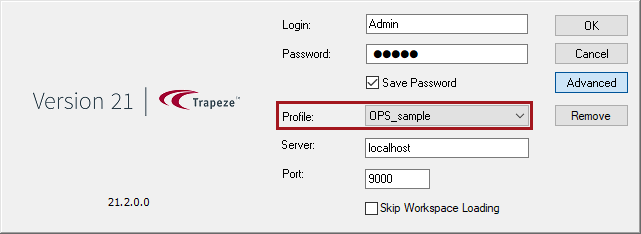
Trapeze products can have multiple locations where properties are found. For example, in the Trapeze4 Workstation, user-defined properties are found under , and options here may change depending on what screen (for example, Trip Booking) is open in the Workstation.
System properties are also available in the Trapeze4 Workstation (under ). These properties define various aspects of how Trapeze4 functions (for example, PASS Booking Client properties).
A more global set of properties is available in the Trapeze6 Client Shell (typically found under , but possibly elsewhere depending on system configuration). These can affect various Trapeze applications, including the Trapeze4 Workstation and web-based applications. These properties can also be accessed in some web-based applications, where they're typically called Context Properties. Available properties correspond to what's loaded in the Trapeze6 Service Shell.
property tag
Vehicle identifier used by the dispatcher. Typically, the ID painted on the side of the vehicle. Used primarily in Vontas TransitMaster.
Also called painted on ID.
protocol
Agreed-upon format for transmitting data between two devices.
provider
Organization that provides vehicles or drivers to a transit site.
pull-in
- Action of a vehicle entering the garage area after completing its last drop-off for
the day, including the time required for a run to travel from its last scheduled
stop to the garage.
See also created pull-in/pull-out.
- Deadhead segment from the last revenue point to the garage.
- Scheduled time of a pull-in.
pull-out
- Action of a vehicle’s departure from a garage at the beginning of the day to perform
its scheduled run events, including the time required for a run to travel from the
garage to its first scheduled stop.
See also created pull-in/pull-out.
- Deadhead segment from the garage to the first revenue point.
- Scheduled time of a pull-out.
Push-to-talk Audio Logic controller (PAL)
Interface used to control the voice radio function by locking out the PTT and audio function of the radio until the operator performs a talk request to dispatch.