
Missing Scheduled Trips Policy Examples
If you are preparing to configure your policy in Service Infractions, you need to understand the available options and what choices need to be made so that the policy will behave in the desired way.
Understanding What Type of Policy You Need
It is possible to create multi-period fixed duration policies that take into consideration activity over more than one period. Multi-period cases look for infractions accumulated within specific months. They have a case lifespan, which defines how many months into the past the system should check for information about prior sanctions. If the case lifespan is >1, the case remains open for the defined number of months (for example, if the case life span is 5, then the case remains open for 5 months). If all of the months pass without reaching the defined thresholds again within a single month, then the case is closed.
Let's look at two examples of a multi-period infractions-based policy where the case life span is three months.
Both examples assume that a client has an open case and has reached an infraction threshold qualifying for a sanction:
- If a client has been clean for two months, and then incurs more
infractions, the new infractions are added to the case and the case is kept open
at least another three months.
The new sanction level is determined as the lesser of what is justified by the number of infractions in the current period or one level higher than what was previously imposed during the defined case life span (that is, within the last three months).
- If a client goes three months without incurring enough infractions to reach any sanction level, the case is closed. If the client later incurs more infractions, a new case is opened and if a sanction threshold is reached the sanction starts over with a level 1 warning letter.
All of the examples offered here assume that clients will be penalized two points for a no-show or cancel at door, and one point for a late cancel.
Example 1: Fixed-Duration Points-Based Policy Based on Suspensions
In this policy, the severity of the suspension depends on the number of previous suspensions in the period.
A defined number of points accumulated in a defined period triggers a response. The sanction level depends on how many points are incurred and how many suspensions have previously been imposed on the client. Different thresholds can be assigned for each sanction level.
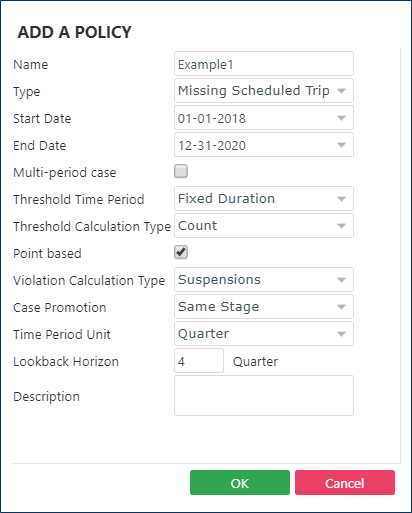
In this example, thresholds are the same for each sanction level: three (or more) points accumulated within a quarter trigger a response. The defined sanction levels are warning, second warning, first suspension (three days), second suspension (seven days), and three or more suspensions (fourteen days).
- The first three (or more) points accumulated by the client within a quarter results in a warning letter.
- The second set of three points accumulated within the same quarter results in a second warning letter.
- The third set of three points accumulated within the same quarter results in
a suspension.
The length of the first suspension is three days.
- If the client has already been suspended once in the past year, they will receive a seven-day suspension.
- If the client has been suspended twice in the past year, they will receive a fourteen-day suspension.
While infraction points are counted within the quarter, previous suspensions are counted within the lookback horizon (or from the policy’s start date).
Any accumulated points are no longer valid at the start of each new quarter. In each new quarter, sanctions start over with a warning letter. However, if the client gets to a violation stage, the suspension is one level above the highest suspension level applied to the client within the past year (lookback horizon of 4 quarters).
This would be set up as a fixed duration suspension-based policy based on quarters, with a lookback horizon of four quarters.
Example 2: Fixed-Duration Percentage Points-Based Policy Based on Infractions
In this policy, the severity of the suspension depends on the number of infraction points coupled with the overall percentage of missing scheduled trips. Different thresholds must be assigned for each sanction level.
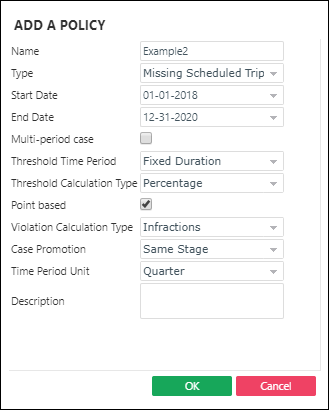
In this example, point thresholds are the same for each sanction level: three (or more) points accumulated within a quarter allows a response to be triggered.
The defined sanction levels are warning (achieved with a threshold value of 5%), second warning (achieved with a threshold value of 10%), first suspension of three days (achieved with a threshold value of 15%), second suspension of seven days (achieved with a threshold value of 20%), and three or more suspensions of fourteen days (achieved by again reaching a threshold value of 20% or greater).
Cases are promoted to the next applicable level (that is, within the same stage), not the greatest applicable level (that is, the highest stage).
- The first three (or more) points accumulated by the client within a quarter with a missing scheduled trips percentage of 5% results in a warning letter.
- The second set of three (or more) points accumulated in the same quarter with a missing scheduled trips percentage of 10% results in a second warning letter.
- The third set of three (or more) points accumulated in the same quarter with
a missing scheduled trips percentage of 15% results in a suspension.
The length of the first suspension is three days.
- The fourth set of three (or more) points accumulated in the same quarter
with a missing scheduled trips percentage of 20% within the same
quarter.
The length of the second suspension is seven days.
- The fifth set of three (or more) points accumulated in the same quarter with
a missing scheduled trips percentage of 20% results in a suspension.
The length of the third suspension is fourteen days.
This would be set up as a fixed duration infractions-based policy based on quarters.
Example 3: Multi-Period Percentage Points-Based Policy
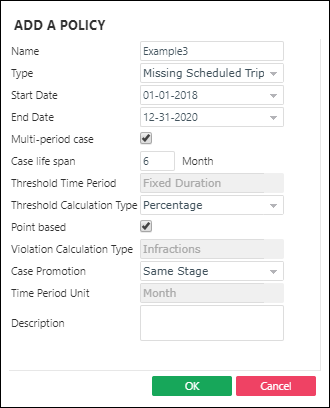
In this policy, the severity of the suspension is based on the highest sanction level achieved in the last six months. Multi-period policies are infractions-based and use month-long time periods. Multiple sanctions can be accumulated in a one-month period.
- Three (or more) points accumulated by the client within a month when a missing scheduled trips percentage of 10% is achieved results in a warning letter.
- Three (or more) points accumulated by the client in the second month when a missing scheduled trips percentage of 10% is achieved results in a second warning letter.
- Three (or more) points accumulated by the client in the third month when a
missing scheduled trips percentage of 10% is achieved results in a
suspension.
The length of the first suspension is three days.
- Three (or more) points accumulated by the client in the fourth month when a
missing scheduled trips percentage of 10% is achieved results in a
suspension.
The length of the second suspension is seven days.
-
No points are accumulated by the client in months five, six, and seven.
-
Three (or more) points accumulated by the client in the eighth month when a missing scheduled trips percentage of 10% is achieved results in a suspension.
The length of the third suspension is fourteen days.
The client receives a fourteen-day suspension because they have already received a seven-day suspension in the six-month case life span period.
This would be set up as a fixed duration multi-period infraction-based policy with a case life span of six months.
Example 4: Flag Periods Percentage Points-Based Policy
In this policy, the severity of the suspension is based on the number of previous periods in which the client met a minimum infraction level.
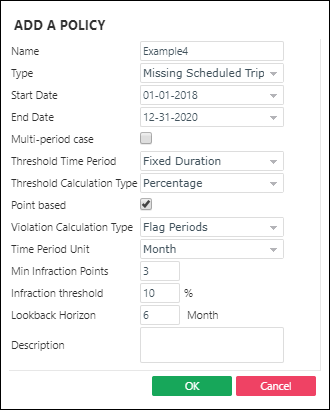
In this example, thresholds are the same for each sanction level: three (or more) points accumulated within a month where a missing scheduled trips percentage of 10% or higher is achieved triggers a response.
The defined sanction levels are warning, second warning, first suspension (three days), second suspension (seven days), and three or more suspensions (fourteen days).
- Three (or more) points accumulated by the client within a month when a missing scheduled trips percentage of 10% is achieved results in a warning letter. This month is flagged.
- Three (or more) points accumulated by the client within the second month when a missing scheduled trips percentage of 10% is achieved results in a second warning letter. This month is flagged.
- Three (or more) points accumulated by the client within the third month when
a missing scheduled trips percentage of 10% is achieved results in a
suspension. This month is flagged.
The length of the first suspension is three days.
- Three (or more) points accumulated by the client within the fourth month
when a missing scheduled trips percentage of 10% is achieved results in a
suspension. This month is flagged.
The length of the second suspension is seven days.
-
No points are accumulated by the client in the fifth, sixth, seventh, and eighth months. These months are not flagged.
-
Three (or more) points accumulated by the client within the ninth month when a missing scheduled trips percentage of 10% is achieved results in a suspension. This month is flagged.
The length of the suspension is three days.
The client receives a three-day suspension because there have only been two one-month periods (months three and four) within the last six months (months three, four, five, six, seven, and eight) that have been flagged.
This would be set up as a flag-period policy based on months, with a lookback horizon of six periods.
Example 5: Rolling Window Points-Based Policy
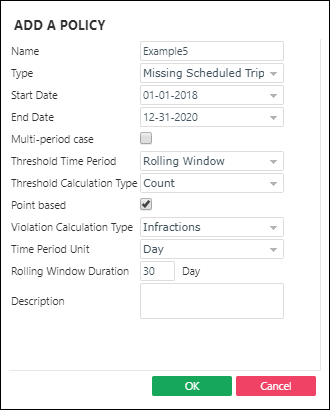
In this example, thresholds are based on accumulating one point or three points within a 30-day period. The defined sanction levels are warning, second warning, first suspension (three days), second suspension (seven days), and three or more suspensions (fourteen days).
- One point accumulated by the client within the previous thirty days results in a warning letter.
- One point accumulated by the client within thirty days of the first infraction results in a second warning letter.
- One point accumulated by the client within thirty days of the second
infraction results in a suspension.
The length of the first suspension is three days.
- Three points accumulated by the client within thirty days of the first
suspension results in a suspension.
The length of the second suspension is seven days.
-
Three points accumulated by the client within thirty days of the second suspension results in a suspension.
The length of the suspension is fourteen days.
This would be set up as a 30-day rolling window infractions-based policy.