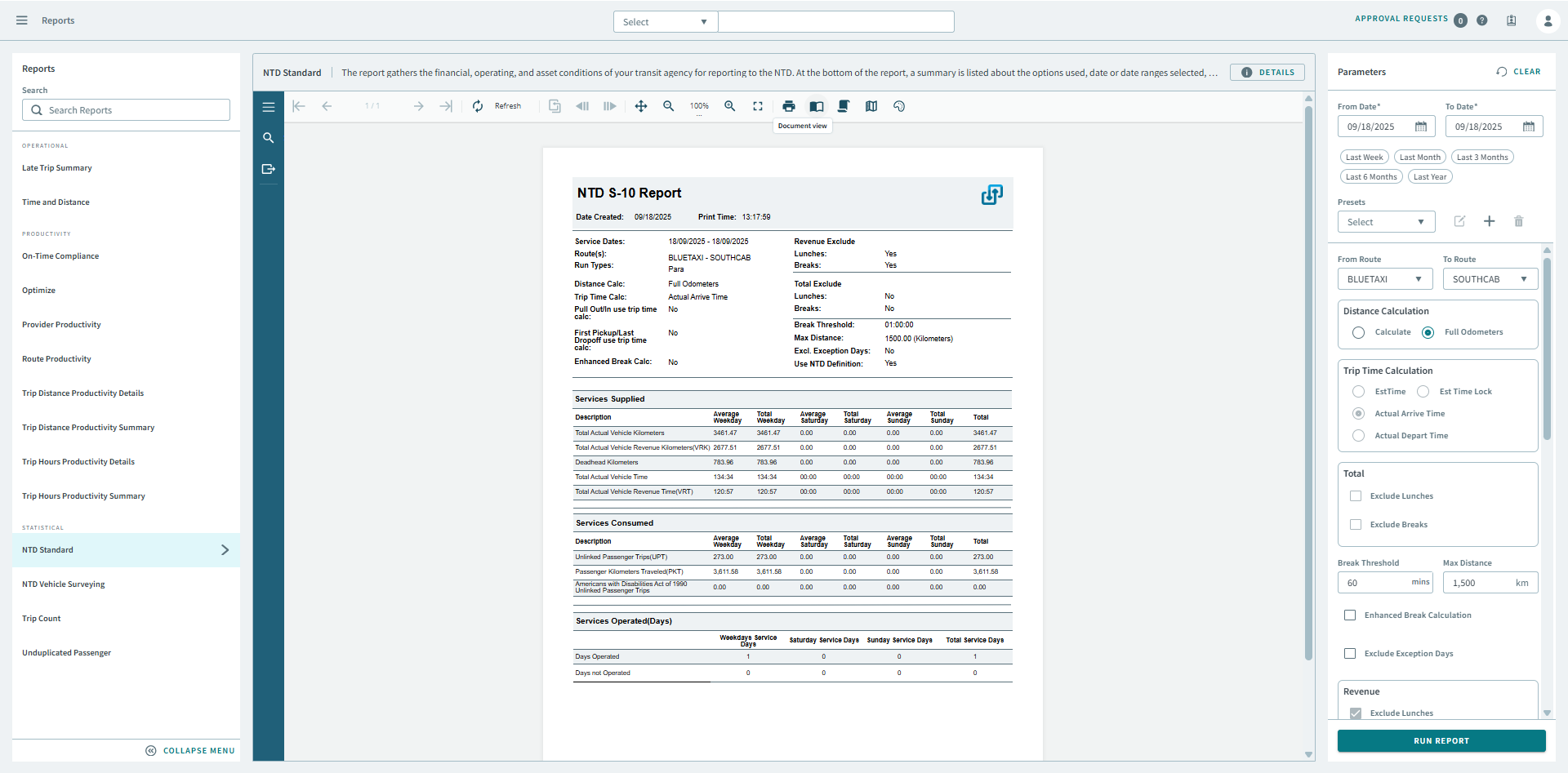
NTD Standard
The NTD Standard Report gathers service data for NTD reporting. The report is similar to the Trip Hours and Trip Miles Productivity standard reports. At the bottom of the report, a summary is listed about the options used, date or date ranges selected, and the user who generated the report.
| Parameter | Description |
|---|---|
| From Date | First date of records in the report. |
| To Date | Last date of records in the report. |
| Presets | From the drop-down, Select a report parameter configuration. Preset icons allow you to edit a preset, create a new preset, or delete a preset. |
| From Route | First route in the report. |
| To Route | Last route in the report. |
| Distance Calculation | If Calculate is selected, distances are based on PASS calculated distances. If Full Odometers is selected, actual odometer readings are used. The Full Odometers option is not recommended unless you have mobile data to ensure complete odometer readings. If Partial Odometers is selected, the report uses odometer readings when they are available and calculated distances when odometer readings are not available. |
| Trip Time Calculation | Trip Time used in the report:
Note: The Trip Time should be set to the Est
Time or the time that is entered in the Schedule Editor. For
example, do not select Actual Arrive Time if you have not
entered these times. |
| Total | Select any of the following to exclude from total distance and total
time:
|
| Break Threshold |
Time in minutes a break must exceed to be removed from the service calculations. For example, if the Break Threshold is set at 60 and an out-of-service break takes 90 minutes, the break will be excluded from service time. A 15 minute out-of-service break would not be excluded. |
| Max Distance | Maximum distance for a single route. If the total distance of a route is greater than this value, it is considered an error and set to 0. |
| Enhanced Break Calculation | If selected, the break duration is calculated from the last drop before the break to the first pick after the break. If cleared, the break time is computed from the break arrive time to the break depart time. |
| Exclude exception days | If selected, the report will ignore days marked as exception days (for example, holidays that run on Sunday service). |
| Revenue |
Select any of the following to exclude from revenue hours and
distances:
|
| Pull out/in use sort time | If selected, the selected sort time is used as the pull out/in time. |
| First Pickup/Last DropOff use trip time calculation method | First pick-ups normally use the actual arrival time and last drop-offs normally use the actual departure time (overriding the selected sort time method). If selected, the system will use the selected sort time (for example, Est Time) for the first pick-up and last drop-off. |
| Provider(s) | If All is selected, records for all providers appear in the report. If All is cleared, select individual providers from the list. The options available to you depend on provider security. |
| Funding Source | If All is selected, the report includes data for all funding sources. If All is cleared, select funding sources from the list. |
| Treat Exception Days As | If exception days (typically holidays) are included, select how they
should be treated in report calculations:
|
| Run Type | Run types to include in the report:
|
| ADA Rule | If All is selected, the report includes data on line 19 for all
funding sources. If not all funding sources count as ADA trips, clear
All and choose only those funding sources that may be used for ADA
trips. Note: Not all funding sources that pay
for trips are considered ADA (for example, a contract with a Senior
Center outside of the ADA service area). |
| Passenger Type | If All is selected, records for all passenger types are included. If All is cleared, select a passenger type (for example, CLI or COM) for the report from the list. |
| Use NTD Definitions |
Use NTD Definitions Select to ignore all other parameter options and use NTD (National Transit Database) definitions. If a schedule has no scheduled, arrived, or performed trips, it will not be included as a service day in the daily averages. To conform to NTD definitions, the report works in the following way:
*Note that calculations for miles and hours may differ slightly from manually calculated values. This occurs because the report rounds numbers during the intermediate steps of the calculation instead of rounding the final calculated value. |